Embodied Genealogy
research
recover
Reconnect
RevivE!
A gently guided audio course on developing research skills for reconnecting with lineage, land, and kin.
October 19th- Nov 16th, 2026
Do you long for a bodily connection with your lineages and ancestors, but don’t know where or how to begin?
You are not alone. Genealogical research can be daunting, not to mention all that it leaves out. There is so much more to knowing our ancestors than reading names and dates on a page.
We can learn just as much about their lives from their lullabies, recipes, stories that warned and stories that healed, illnesses that ran in the family, and all the things we were taught not to say.
Genealogy can often be practiced as the accumulation of dates and names with little connection to land or embodiment. While this approach can offer us a kind of map, when we bring a more sensory and embodied lens to our research, so much more is revealed.
Some of us may not have access to genealogical information for reasons of violence, displacement, or estrangement. Others were raised inside of families with whom we don’t share biology. We are also shaped by the families we choose, and the cultures in which we build belonging. There should be room for all of this in genealogical research.
We still have lineage, we still have ancestors, and we can still trace threads that weave us back into deep belonging with kin and place.
This audio course is designed for the genealogy curious to invest in their relationships with ancestors and the lands they called home. Material provides a supportive structure for participants to undertake self-guided research at a pace and scale that is accessible and digestible. We’ll have built in check-ins to share progress, challenges, and questions as they arise. Through personal exploration, participants will build confidence in identifying, uncovering, and connecting with their ancestral roots from a variety of sources.
What’s included
Four audio lectures + corresponding practices that explore ancestral research through embodied, politicized, and genealogical frameworks.
Workshop with Marika (live + recorded).
Fully transcribed and downloadable lessons for lifetime access.
Reading list and Community resource library.

“Marika’s accompaniment helped to tether ancestral loose ends into a braided present. She invoked lineage inquiry that we had otherwise overlooked for fear, for overwhelm or for the sheer enormity of what it is to recall the names of our dead. Marika contained and invited whole story to surface itself from the muddy waters of our subconscious that has given breath to the emergence of so many new stirrings here at Land Clinic. We consider Marika a dear one, touched by her ability to witness and grateful for her offerings as a sound vessel to this time.”
— Anastasia Maier, Cheyenne Reynoso, and Ian Schiffer of Land Clinic
Course details
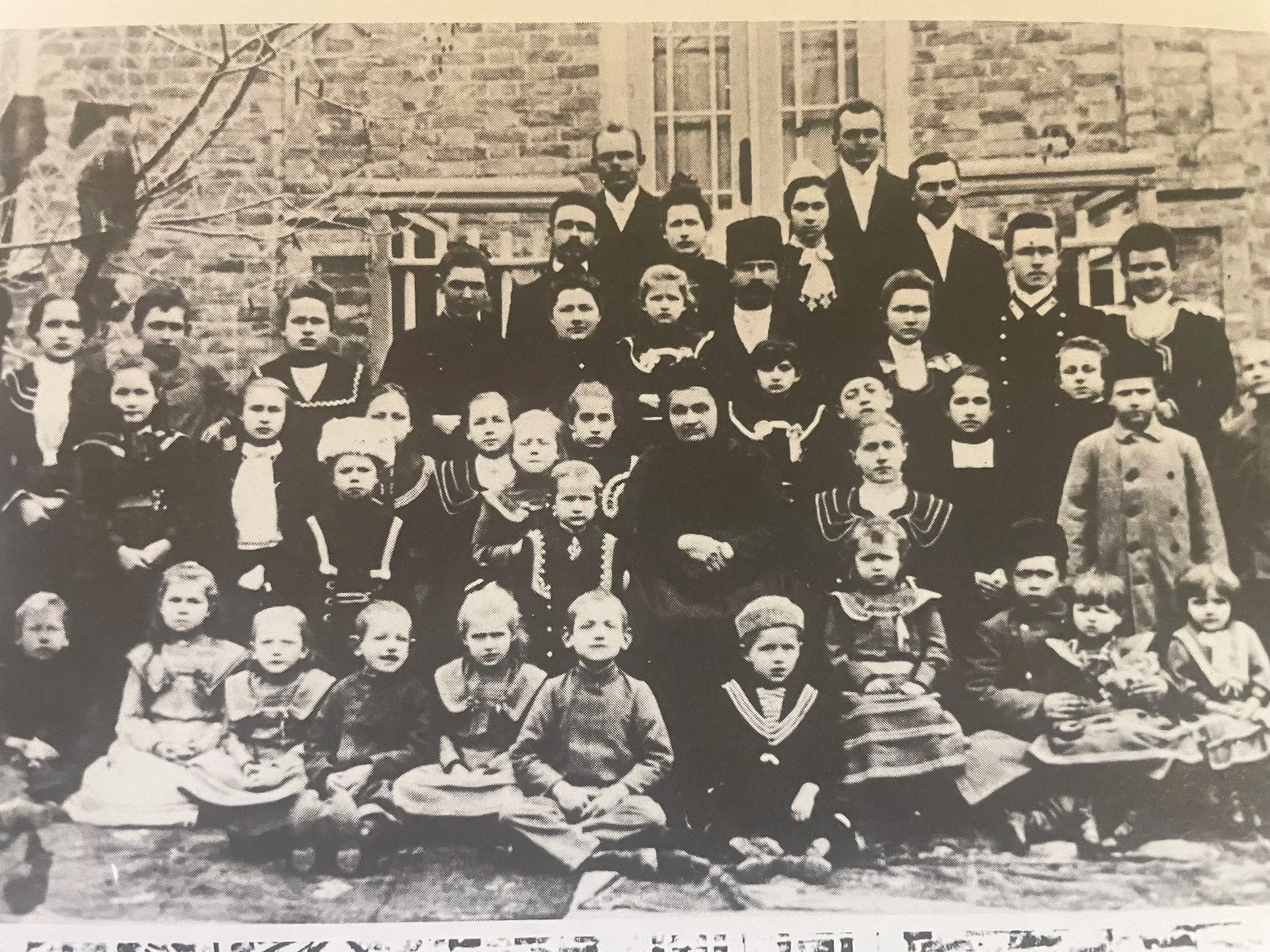
The grandchildren of my great uncle Julius Heinrichs (1904), Mennonite settlers in Russia.
This course offers an intimate and self-guided container for research and exploration through audio lectures, guided practices, a resource library, and optional live Q+A.
Embodied Genealogy is open to anyone with an interest in learning about their history— with a recognition that material is taught through an anti-racist, anti-colonial, queer and trans affirming, and trauma-informed lens.
We will explore three layers of research and their corresponding somatic states. Each lesson includes a blend of lecture, embodied practice, and teachings on topics related to Embodied Inquiry, Historical Research, and Genealogy.
While healing may happen, and some somatic tools are shared, this course is not a replacement for therapy or other types of 1:1 support with a qualified practitioner.
Important dates:
Our course begins October 19th.
Modules are released on Mondays: October 19th, 26th, November 2nd, and 16th.
Live Workshop/ Q+A on November 8th from
10am - 12pm PT / 1pm - 3pm ET
Deadline to register: November 6th
Questions you don’t find answered here? Reach out to Wren: assistant @ wildbody.ca for support.
“Sometimes we don't know who we're from, what lands we're from, what culture we're from, what language we're from. But that culture, those ancestors, that language, know exactly who we are.”
— Ben Reid-Howells, Lost Together PodcastCourse Outline
-
Week 1: October 19th // Mapping Systems + Power
This layer of research asks us to explore the conditions in which our peoples lived, and how those conditions shaped their lives. Whether we lack specific names and dates, or want to better understand the choices our ancestors made — the contexts in which they lived are vital to understanding their lives with compassion and curiosity.
Did your people leave their homelands? What were the conditions of their staying or of their departure? How did your ancestors’ lives relate to broader patterns of migration, colonization, and violence?
Participants will learn skills for self- guided research into political, cultural, and economic histories from a variety of sources. Through structured prompts and exercises we will explore how to track clues and connect broader themes with patterns in our own families and lineages.
-
Week 2: October 26th // Somatic + Ancestral Inquiry
Our bodies, nervous systems, and survival responses are just as much a source of ancestral information as any book or family tree. What values and messages were you taught about expressing emotions? How does your body respond when you hear a song in the language of your ancestors?
In this layer of research we will explore how our bodies hold memory and stories that may be older than our lifetimes. How might emotion, mood, heart rate, and imagery all help us to learn about who we come from, and build reciprocal and nourishing relationships with them now?
In this module participants will explore through experiential practices — including mapping our Nervous System Family Trees — how to sense into the wisdom and cellular memory that our bodies all carry.
-
Week 3: November 2nd // Radical Genealogy
This layer of research dives into the details and patterns of our lineages which when combined with other modules, can bring the intimacy of our ancestral connections to life. We’ll explore a range of sources for our research, bringing a critical approach to genealogical information gathering.
How do we ask our family members about our history? What do census records, marriage certificates, and wills have to teach us — and how do we find them?
This module will offer practical guidance and tools for research, alongside frameworks for approaching challenges that can arise in genealogical work. We’ll consider particular questions for marginalized groups, as well as those whose ancestors were complicit in collective harm.
-
Week 4: November 8th // Live Workshop Q+A
Join Marika alongside course participants for a live Q+A on all things research. There will also be time for a live practice to support the integration of course themes and material.
Workshop will take place from 10am - 12pm PT / 1pm - 3pm ET
-
Week 5: November 16th // Reweaving our Ancestral Stories
Culture changes over time when the stories we tell about who we are can hold truths that have been erased or forgotten. When the wounds of our people are brought back into connection and remembrance something different becomes possible for ourselves, and for future generations.
This module will integrate the styles of research taught throughout the course. Prompts and practices will support lineage repair around story, relationship, and accountability.
-
Audio lecutures + guided practices
Each lesson includes a fully transcribed 45-60 min audio lecture and guided practice or research prompts to help illuminate key concepts and break research into small approachable steps.
-
Reading List + Resource Library
You will have access to a course reading list alongside a community generated library of articles, podcasts, books, and other materials to aid your research. Move through the material at your own pace and come back to the modules anytime.
-
Downloads + Lifetime Access
All of the resources in Embodied Genealogy can be downloaded and saved for your ongoing research.
Pricing
$150 usD
Registration closes November 6th, 2026
Your Guide

Marika Heinrichs (She/her)
Marika is a somatic practitioner, writer, and facilitator. Her work focuses on the recovery of ancestral wisdom through body-based ways of knowing as a pathway for people of European descent to de-assimilate from whiteness and unwind from domination and supremacy. Marika’s people come from Ukraine, Germany, Britain and Ireland and she was born, raised, and lives on Dish with One Spoon treaty territory in so-called Guelph, Canada.
You can learn more about her here.